Logo
Showing posts with label Finance. Show all posts

Jul 19, 2009

Is the era of supernormal growth for Google Inc over?

The phenomenal growth witnessed by Google Inc during the start of this decade is gradually slowing down. Google’s revenues had jumped 250 times in 7 years from 2001 to 2008 showing a compounded annual growth rate (CAGR) of 120%. The profits even fared better with the net profits in 2008 being more than 600 times the net profits in 2001 – a CAGR of 150%. However, Google’s revenue growth rate has been slowing down as its size is increasing. The annual growth rate which was more than 400% in 2002 has gradually fallen to about 30% in 2008 and in the first half of 2009 the growth rate was in single digit.

Has Google’s growth matured? Is Google’s supernormal growth phase behind us? It is quite possible as suggested by the trend in the growth rates. Google is now one-third the size of Microsoft and one-fifth of IBM. For a company that was incorporated only 11 years ago - growing to such a size is amazing. Continuing to show such phenomenal growth is not sustainable in long term. If Google can grow by more than 25% in next 4-5 years it would be a significant achievement. A growth rate more than that will require entering into other related businesses. Google has done it in past and is very capable of doing it in future. With plans of entering into the Operating System business which has Microsoft's dominance, Google has a huge potential opportunity which if it can unleash will help it grow even faster.

May 5, 2009

Top Bank holding companies in US by total domestic deposits

The biggest domestic deposit banks on June 30, 2008 as per the data published by FDIC were:
Bank Name Deposits
(Jun 2008)
billion $
BoA Corp 701.5
JP Morgan Chase 497.2
Wachovia 422.0
Wells Fargo 293.4
Citigroup 271.3
US Bancorp 127.8
Suntrust Bank 115.6
National City Corp 97.8
RBS 95.3
Toronto-Dominion Bank 89.8

Of these the last two were foreign banks. In all there were 12 foreign banks in the top 50 list.


Bank Name Deposits (Jun 2008) billion $
1 RBS Group 95.3
2 Toronto-Dominion Bank 89.8
3 HSBC Holdings 83.0
4 Banco Santander 53.8
5 BNP Paribas 43.9
6 Mitsubishi UFJ 42.0
7 BBVA 39.4
8 Allied Irish Bank 36.5
9 Bank of Montreal 29.1
10 UBS 24.4
11 Royal Bank of Canada 17.8
12


Source:
Deutsche Bank


FDIC
15.2


Jan 17, 2009

Top 20 non-banking finance companies of India

The top finance companies of India excluding banks when ranked on their market value were following as on 17 Jan 2008.

Company Name Market Cap. (Rs. Billion)*
HDFC 445.3
Power Finance Corp. 150.1
Reliance Capital 105.2
IDFC 77.1
Rural Electricity Corp. 67.4
Shree Global
61.5
Shriram Transport Finance 39.7
Bajaj Finserv 27.1
Indiabulls 25.7
Religare Enterprises 24.5
Bajaj Holdings 23.5
M&M Financial 22.6
LIC Housing Finance 20.1
Edelweiss Capital 17.9
KGN Industries 17.1
Shriram City 15.8
IFCI 15.8
JM Financial 15.8
India Infoline 13.1
Centrum Finance 11.1


*as on Jan 17 2008.

Housing Development Finance Corporation Limited (HDFC) headquartered in Mumbai is the biggest private sector public housing mortgage company. Its major shareholders are Foreign Institutional Investors with about 59% holdings. FDI holds 15% while Insurance companies and mutual funds hold about 12% of its shares. Citigroup through its Mauritius subsidiary, Citigroup Strategic Holdings Mauritius Ltd, is the biggest shareholder with 9.1% in HDFC.

Power Finance Corporation Ltd (PFC) is one of the Navratna Public Sector Undertakings (the best government companies in India). PFC is the provider of large range of financial products in the power finance sector. It is playing an important role in developing India’s power sector.

Reliance Capital Ltd, a Reliance - Anil Dhirubhai Ambani Group (aka ADAG) company, is one of India’s fastest growing private sector financial services firm. Reliance Capital has business spread across domains like asset management, insurance, private equity, stock broking, depository services, consumer finance etc. Promoters group holds 53% of shares in Reliance Capital.

Jan 27, 2008

How good is ‘Decoupling theory for India, China and other emerging economies?

The Decoupling theory is that emerging economies like China and India are decoupled from the US economy. The view is that the emerging economies on one hand and US economy are now very less related. How good is that assumption?

If we look merely at the GDP growth figures China and India are accelerating at 11% and 9% per annum, while US is in a slow growth phase an may even enter into recession in the coming year. This may help us in believing the decoupling theory and that China and India can keep on growing without getting affected from the US economic condition.

If we look slightly deep into it and look at two major sources of GDP: consumption & investments, we will find that although US economy has experienced a slower growth, its consumption is in healthy growth phase, and the slowdown in overall growth is mainly because of slowdown in investment activities from US firms. The reason may be that a lot of money is moving in the form of FII and FDI to India and China. Even China and India export heavily to US, so a slowdown in consumption in US is bound to affect these countries, though the extent of the damage may be different.

Investors who believe in decoupling theory think a well diversified portfolio across Asian and American countries can give good returns even in the case of US recession. That may be too optimistic assumption and this is one of the factors behind the huge rally that was seen in the Chinese and Indian stock markets in the past year. But the recent tremors shook the belief and markets all over the world fell sharply in two days following news on US economic recession.

Earlier during the subprime crisis the decoupling theory got seriously challenged. The credit crunch that followed was not a US only phenomenon, though US was hard hit. The decoupling theory also underestimates the fact that economies are in era of globalization, and recession in one big economy is bound to cause some pain in other economies.

If we look at world economy, US constitute about 22% of world GDP, while China is about 11%, India 4.6% of world GDP. So if the world economy has to grow, a recession in US economy has to be countered by a bigger increase in other economies. The decoupling theory also suffered some blow when World Bank issued that Chinese and Indian economies are smaller than that estimated earlier.

The year ahead will only tell us how independent these emerging economies are from US and whether their growth can compensate for the world slowdown if US economy goes into recession.

Jan 17, 2008

Applying Dividend Discount Model (DDM) to 'State Bank of India' (SBI)

Dividend Discount Model values a firm's equity on the basis of the future dividends that the company is expected to give. Discounting all the future dividends gives the value of the stock as this is the only money an investor is going to get if he keeps the stock till perpetuity.

The general valuation formula for DDM is:
P = D1/(k - g)

where
P - ideal price of the stock
D1 - dividends for the year 1
k - cost of equity/ discounting rate
g - growth rate of the dividends

There are some assumptions in this model which require careful use of this model for finding the intrinsic value of a stock based on its dividends.

We will use a live example of State Bank of India (SBI) to illustrate the use of DDM. The following is the last 10 year dividend history of the company:

Year End Total Dividends paid (Rs crores) PAT (Rs crores) Retained Earnings (Rs crores) Retention ratio, b
Mar-98 211 1861 1650 0.89
Mar-99 211 1029 818 0.8
Mar-00 263 2051 1788 0.87
Mar-01 263 1880 1617 0.86
Mar-02 316 2423 2107 0.87
Mar-03 447 3105 2658 0.86
Mar-04 579 3681 3102 0.84
Mar-05 658 4305 3647 0.85
Mar-06 737 4405 3668 0.83
Mar-07 737 4534 3797 0.84


Using this we find that SBI has policy to retain about 85% of their earnings and distribute 15% as dividends to its shareholders. The retained earnings add on to the shareholder's equity and should earn profits for SBI. For each year we also looked into the returns on the equity (ROE) for SBI. the data is as follows:

Year End Retention ratio, b ROE Growth rate, g
Mar-98 0.89 21.2 18.8
Mar-99 0.8 10.3 8.2
Mar-00 0.87 18.2 15.9
Mar-01 0.86 14.7 12.6
Mar-02 0.87 17 14.7
Mar-03 0.86 19.2 16.4
Mar-04 0.84 19.7 16.6
Mar-05 0.85 19.4 16.5
Mar-06 0.83 17 14.2
Mar-07 0.84 15.4 12.9


We have calculated the growth rate of dividends using:
growth rate = retention ratio X Return on equity ; g = b*ROE
Since dividends next year will be equal to this year's dividends plus the earnings on the retained earnings of this year with SBI.

The average growth rate for the 10 year period was about 14.7%.

SBI paid dividends of Rs 14 per share in 2007. Hence D0 = 14.
D1= 14*(1+g) = 14 * 1.147 ~ 16

Finding the discount rate is the trickiest part of the valuation and it depends on many factors and can be estimated using CAPM or other similar models. For simplifications we will take cost of equity as given in this case. We will take cost of equity as 15% and assume that SBI will enjoy this high growth for next 20 years before settling at something less than India's GDP growth rate (~ 7 %) and find out the value in the next article. Till then you can try it on your own.

[Hint: SBI is currently trading at 2400]


[To be completed in next post...]

Jan 14, 2008

Special Section for CAT / MBA entrance GD/PI Finance articles

This post contains the list of all the Finance articles, in this blog, that may be relevant for CAT or other MBA aspirants preparing for GD/ PI. You may send your request for any relevant article that you want on this blog.

We have two authors for this section: Saurav & Selwyn. They shall be presenting their views & relevant facts on the current topics in Finance.

So far we have these articles in this category. The list will get updated with the new posts.

List of economics articles:
Soaring crude oil prices and its impact on India
Monetary Policy
Rupee appreciation and its after-effect
Economic Fundae - GDP
Economic Fundae - Inflation
Economic Fundae - Exchange Rates

Economic Fundae - Business Cycles
Economic Fundae - Fiscal Policy
Economic Fundae - Interest Rates


List of economics articles:
Stock Markets Basics

To view all the posts with tag CAT in a single page.

Dec 3, 2007

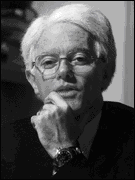
A man called Peter Lynch!!

Wall Street stock investor Peter Lynch is one of the greatest investor of history. He managed the Fidelity Magellan Fund from 1977 to 1990, during which period he beat the S&P 500 index benchmark in 11 of those 13 years, achieving an annual average return of 29%. The fund grew from $20 million in 1977 to $14 billion in 1990. The little known “Fidelity Magellan Fund” became the best performer mutual fund over that period. A $1000 invested in Magellan in 1977 became $21000 by 1990, when Peter Lynch retired after thirteen years.

Often called as a “chameleon”, Peter Lynch adapted to whatever investment style work in that time. The investment Guru says that the ability to think like an amateur has helped him to adapt right kind of strategy. He uses a common –sense approach to investment. Find out the whole story behind the company before buying the stock; then keep following the story after buying the stock. He says, “Don’t sell the stock if the ‘story’ is still good, whether the market is up or down.” In picking stocks Peter Lynch stuck to what he knew or could easily understand. He only invested for the long run and paid little attention to short-term market fluctuations.


Lynch consistently applied set of eight fundamental principles to his stock selection process. According to an article by Kaushal Majmudar, a CFA at Ridgewood Group, Lynch mentions about his checklist at conference in New York in 2005.

Know what you own.

It's futile to predict the economy and interest rates.

You have plenty of time to identify and recognize exceptional companies.

Avoid long shots.

Good management is very important - buy good businesses.

Be flexible and humble, and learn from mistakes.

Before you make a purchase, you should be able to explain why you're buying.

There's always something to worry about.


He is also famous for his books co-authored with John Rothchild on stock picking, “One Up to Wall Street” (1989), “Beating The Street” (1993) and “Learn to Earn” (1996) considered mandatory reading for any investor.

Presently (2007) he is serving as vice-chairman of Fidelity's investment adviser, Fidelity Management & Research Co. He is also involved in many philanthropic work since his retirement.

Some of his famous quotes are:


The Key to making money in stocks is not to get scared out of them.


I think you have to learn that there’s a company behind every stock, and that there’s only one reason why the stocks go up. Companies go from doing poorly to doing g well or small companies grow to large companies.


In this business if you’re good, you’re right six times out of ten. You’re never going to be right nine times out of ten.


Go for a business that any idiot can run – because sooner or later, any idiot probably is going to run it.

Nov 30, 2007

Banks may freeze ARMs as sub-prime aid measure

Treasury Secretary, Fed and leading banks and lenders of sub-prime loans are reportedly working on some plan to extend the teaser rates on mortgages which were scheduled to be reset at higher levels in the coming months. Till now no formal agreement has been reported but things are expected to be made public by next week.

Treasury Department spokeswoman Jennifer Zuccarelli said; “We’ve all agreed that there should be some sort of standardized approach to reaching more homeowners faster,...”


Earlier Federal Reserve Chairman Ben Bernanke has hinted of another cut in interest rate to prevent economy from recession.


Recently a magazine reported Treasury Secretary Henry Paulson’s remark "We'll have broad agreement on criteria that will make it easier to modify mortgages in the volumes we need,...".


This comes at a stage when the foreclosures in this year have already reached about double of last year. A increase in the period with teaser interest rates will provide relief to the home loan takers who may find difficult to pay the increased installment.

Probably in the meeting the concerned authorities may be figuring out a mechanism to selectively give the interest rate rebate to those with good repayment history.


The parties attending the meeting were Treasury Secretary, Fed regulators, officials from OTS (Office of Thrift Supervision), bank executives from Citigroup, JPMorgan Chase & Co., Wells Fargo & Co.’s amongst others.


According to an estimate, about 2 million house owners whose rates are going to be reset and may face foreclosures in 2008 if defaulted.

Nov 29, 2007

Top 10 financial cities of the world

The top 10 financial hubs of the world according to a survey by Mastercard in June 2007. The ranking was based on six parameters: Financial flows, ease of doing business, economic stability, legal and political framework, volumes of business, and knowledge creation and dissemination. The ranking was given to 50 cities, the top 10 list goes like this...


Rank

City

1

London

2

New York

3

Tokyo

4

Chicago

5

Hong Kong

6

Singapore

7

Frankfurt

8

Paris

9

Seoul

10

Los Angeles


Source: City Mayors Economics

Nov 25, 2007

Biggest Treasury Scam and Salomon Brothers

About Salomon Brothers: Salomon Brothers & Co. was formed in January, 1910 as a partnership of three brothers – Arthur, Herbert, and Percy; and a clerk, Benjamin Levy. They continued their father’s business of money brokerage with great ambition. But, the firm faced capital crunch and in the same year, April month it merged with Martin Hutzler & Co. It was later acquired by the commodity trading firm Phibro Corporation. The joint company was named at Phibro-Salomon and then Salomon Inc. and the commodity operation were sold. Its greatest dominance came in 1980s when it became known for many innovations in Bond market and created the first “mortgage-backed security”. With time, it became the largest issuer and trader of bonds in the United States. Its dominance can be judged by the fact that in those days a bond was called liquid if it was traded by Salomon brothers.

But, the turning point for which company got so much of media attention came in 1991, when the treasure scam done by company got exposed. By this year, Salomon Brothers had taken control of the U.S. Treasury Bond market. Firm became one of the selected groups of buyers allowed to bid on government securities in the primary market. The securities purchased in the primary market were then sold to general public in secondary market. In order to ensure competition and fairness in primary market, federal regulations prohibited individuals or firms from purchasing more than 35 percent of any bond issue. On three separate occasions, however, Salomon traders exceeded the limit by unethically using the names of its clients for submitting fraudulent bids. Client’s name was used for the bidding without their authorization, cornered the Treasury bond market and firm illegally made millions of dollars of profit.

The scandal involved billions of dollars of illegal bids in the multi trillion-dollar Treasury market. By making such bids, Salomon was able to exert unusual control over the marketplace. But, soon the head of bond-trading desk at Salomon Brothers, Paul W. Mozer, was accused of manipulating the bidding at government auction of Treasury securities. The civil suit, brought by the Securities and Exchange Commission, accused two former managing directors, Paul W. Mozer and Thomas F. Murphy, of falsifying the details and improper bidding for Treasury securities. The then CEO, Mr. John H. Gutfreund and the firm’s president, Mr. Thomas W. Strauss, announced their resignation on account of not taking prompt action even after getting to know in April about the one of the unauthorized bid at a February Treasury auction.

The encouragement of reckless trading culture at the investment firm led to commitment of fraud and constituted a breach of public trust of the most serious kind. It cost Gutfreund his job and Salomon Brothers its independence, almost putting the firm out of business. The scandal is covered extensively in the book Nightmare on WallStreet.

Nov 23, 2007

Warren Buffett : greatest investor

Warren Edward Buffett is unarguably one of the most successful investors of all time. He is a firm believer of the value investing.

Buffett is the third richest person in the world as per the Forbes magazine ranking of September, 2007. His wealth is estimated to be more than $52 billion. Some people call him "Sage of Omaha" or "Oracle of Omaha".

During his Masters degree in economics at Columbia University he studied under Benjamin Graham, the value investor guru. Two other famous value investors - Walter Schloss and Irving Kahn also studied during the same time under Graham.

He is perhaps the biggest financial donator and has committed more than $25 billion. Much of it will be going to the Bill and Melinda Gates Foundation. The foundation is formed by his friend and the world’s richest person Bill Gates.

Recently people started losing faith in Buffett & value investing because of the dot-com bubble and Buffett’s decision to be away from the information technology stocks. His conservative investing style made him miss a big opportunity. But the dot-com crash once again proved that Buffett's strategies are best in long term.

Some of the famous quotes from Mr. Buffett are presented below.

His views on investing:

If you have a harem of 40 women, you never get to know any of them very well.

You are neither right nor wrong because the crowd disagrees with you. You are right because your data and reasoning are right.

Unless you can watch your stock holding decline by 50% without becoming panic-stricken, you should not be in the stock market.

The critical investment factor is determining the intrinsic value of a business and paying a fair or bargain price.

Risk can be greatly reduced by concentrating on only a few holdings.

Be fearful when others are greedy and greedy only when others are fearful.

It is optimism that is the enemy of the rational buyer.

An investor should ordinarily hold a small piece of an outstanding business with the same tenacity that an owner would exhibit if he owned all of that business.

His views on people:
In evaluating people, you look for three qualities: integrity, intelligence, and energy. If you don't have the first, the other two will kill you.

Alan Greenspan: ex-chairman US Federal Reserve

This is first article of the series of some of the famous people in the financial world. Below is a brief introduction of Alan Greenspan.


Alan Greenspan is the former Chairman of the US Federal Reserve Board of Governors.

His tenure at Fed lasted 18 years from 1987 until early 2006. He was appointed five times during this period. He was successively appointed by four US presidents: Ronald Reagan, George H.W. Bush, Bill Clinton and George W. Bush

During his tenure as Fed’s chairman, he was regarded as one of the most powerful financial men in US. Even today he is thought by many as having considerable influence over economic affairs.

He is known for his policies on keeping inflation in US at historically low levels. But, he is disapproved by many people for focusing too much prices and neglecting its impact on employment. He is also criticized for the high volatility in US economy more so in the 1990s period when dot-com bubble was taking place.

He was succeeded by former Princeton economics department chair Ben Bernanke.

Nov 21, 2007

What are hedge funds?

Hedging means reducing risk of adverse price movements in a security generally by taking an offsetting position in a related security. So, essentially hedging leads to lower risks.

The term "hedge" was coined by the agriculture industry and farmers were the first "hedgers". They hedged the risk of losing their agricultural produce. Insurance is also a type of hedging method.

A Hedge Fund is fund which can take advantages of any of the hedging strategies, trade in any financial instrument, but produce above average gains at reduced risks. A hedge fund is genrally expected to have positive returns under all market conditions.

Timeline of Hedge Funds
In 1949: Alfred Jones started first hedge fund in the US
In 2005: USD 1 trillion industry with 9,000 Hedge Funds
Oct 2007: Hedge Funds: 2.5 trillion USD

By some estimates the size of Hedge Funds industry has crossed 3 trillion dollars. This is huge when we consider the fact that the total domestic market capitalization of all the stock markets of the world is less than 60 trillion dollars and that of NASDAQ is 4 trillion dollars.

Oct 30, 2007

Sensex crosses 20k and Ambani crosses Gates

Mukesh Ambani, of Reliance Industries Ltd, became the world's richest man on 29 October, overtaking Microsoft's Bill Gates and Mexican Carlos Slim Helu. The feat was achieved because of the strong rally which the stocks of Ambani's Reliance Industries has been witnessing since last month. The Reliance Industries Ltd stock has risen more than 60% in past few months and has helped Bombay Stock Exchange's 50-stock index Sensex to cross 20,000 points and take Mukesh Ambani's net worth to $63.2billion just piping Helu and Gates who are a little behind at around $62.29bn each. Ambani holds more than 50% shares of Reliance Industries.

Estimates of the wealth of the top five richest person of the world are:

Mukesh Ambani - $63.2 billion
Carlos Slim Helu - $62.3 billion
Bill Gates - $62.3 billion
Warren Buffett - $55.9 billion
Lakshmi Mittal - $50.9 billion

Sep 30, 2007

Financial Ratios

Profitability Ratios
Liquidity Ratios
Solvency Ratios
Capital Market Ratios

Profitability Ratios:
Profit Margin
Asset Turnover
Return on Assets
Return on Equity

Liquidity Ratios
Current Ratio
Quick Ratio
Debtor Turnover
Inventory Turnover

Solvency Ratios
Debt-equity Ratio
Liability-equity Ratio
Interest Coverage Ratio

Capital Market Ratios
Price-earnings Ratio
Dividend Yield
Price-book value Ratio
Beta

What is Cash Flow Statement?

Summary of cash inflow and outflow in a given period
Three Parts:
1. Due to Operating Activities
2. Due to Investment Activities
3. Due to Financing Activities

Two methods : Direct & Indirect

What is Income Statement?

Income or Profit and Loss (P/L) Statement
For any period of time

Starts with Revenues (Sales)
Less : Cost of Goods Sold
Gross Profit
Less : Operating Expenses
Less : Selling & Administration
Less : Depreciation
Operating Profit
Less : Interest Expense
Profit before Tax
Less : Taxes
Profit After Tax
Less : Dividends
Retained Earnings in Balance Sheet

What is Balance Sheet?

Company's financial position at any point of time.
Shows the balances of all the accounts at one place.
Shows Assets, Liabilities and Shareholder's Equity
Summarizes the resources and the claims of owners and creditors

Structure:
Account Form
Indian : Liabilities & Shareholder's Equity - Left Column; Assets - Right Column
American : Assets - Left Column; Liabilities & Shareholder's Equity - Right Column
Report Form
Indian : Liabilities & Shareholder's Equity followed by Assets
American : Assets followed by Liabilities & Shareholder's Equity

Order:
American; In descending order of liquidity
On Left Side:Cash comes first; fixed assets last.
On Right Side:Accounts payable first; Shareholder's Equity Last.

Items in Balance Sheet (B/S)
Assets
Cash & Cash Equivalents
Accounts Receivable/Debtors
Inventories
Property/plant/equipment
-Accumulated Depreciation
Intangible Assets like patents, rights etc.
Liability & Equity
Accounts payable (spontaneous liability)
Accrued Expenses (spontaneous liability)
Deferred taxes
Long-term debt
Stockholder's equity (prference and common)
Retained earnings
-Treasury stock(common shares in reserve)

Sub-prime crisis - Origin and Impact

The origins of this crisis can be traced from late 1990s, when the dotcom bubble started. After the crash of the dotcom bubble in 2000s most of the countries including US were facing economic recession. Interest rates were low during these periods and lending standards were not good. This led to the rise of another bubble in 2001 in the form of real estate. The prices of the real estate property sky rocketed during this period. There was a rat-race for buying houses and people were taking loans as it was very cheaply and easily available. Lending agencies used innovative products to attract customers. During 2004 through 2006, concepts like ‘teaser rates’ became popular in mortgages. These teaser rates (initial low interest rate) applied through varied time period, ranging from few months to couple of years depending on the mortgage creditworthiness. The thing which the borrowers forgot was that at the end of this freedom period the rates can rise rapidly, raising the minimum instalment to be paid out of their capacity. During this period lenders were so confident that they qualified borrowers only by their ability to pay the teaser rates.

One may trace the sub-prime crisis to the securitization – conversion of home mortgages into bonds. The man behind securitization was an Investment Banker of 'Salomon Brothers' - Lewis S. Ranieri. In 1980s Salomon launched Mortgage-Based Securities (MBS) – bonds with bundles of mortgages, bought from bank lenders, as collateral. For this, Salomon used a special purpose vehicle known as Collateralized Mortgage Obligation (CMO). Monthly instalment was used to pay the interest on these bonds. We will discuss about securitization separately.

Securitization had some negative implications on the mortgage standards. Since anyone can originate a loan and sell it to the Investments Banks, which package them and sell them as MBS, it lead to originators writing risky loans as they need not worry about the payback of loan. This problem was dealt by slicing MBS into tranches on the basis of the risk profile. These tranches which may have different maturity period were given ratings by credit rating agencies like S&P and Fitch. The most risky tranches were difficult to sell except for the hedge funds and some pension funds. These hedge funds were so eager to buy these securities that they didn’t care about the huge impending risk associated with these tranches and continued to invest in them.

With the collapse of the housing bubble in mid 2005 real property price declined so much that many owners holding became negative equity, mortgage debt became higher than the value of the property. During the housing bubble, many property owners used their property as collateral to raise money for consumer spending. With the crash of housing markets these lenders faced huge defaulter problem and were unable to recover their losses.

Aggravating the issue was the rising interest rates, coupled with the maturity of the freedom period of teaser rates, which increased the monthly payments. Many house owners felt incapable of meeting their financial liabilities and went bankrupt. Amongst the institutional players affected were the sub-prime lenders, banks, housing developers, and investors like hedge funds and pension funds. The impact was not limited only to US, as UK’s leading subprime lender Northern Rock sought bankruptcy protection.

Sub-prime crisis - An Introduction

What is Sub-prime crisis?

In our earlier discussion on sub-prime mortgage, we acknowledged that both creditors and debtors carry high risk in such kind of lending. Sub-prime crisis is the result of those risks.

Sub-prime crisis is associated with the increase in foreclosures of the sub-prime mortgage borrowers. It was significant enough in the year 2006 to create headlines. In year 2007 the total value of the sub-prime mortgages was more than two trillion dollars, which makes about 15 % of the total mortgages. Due to the sub-prime mortgage market meltdown the houses of millions of Americans are under the risk of foreclosure. Over six hundred thousand of such foreclosures were initiated during the first half of 2007.